At eight years old, a swimming accident in Pahalgam took away Satish Gujral's hearing. For sixty-two years, he lived inside that silence. Not as loss. As method.
When cochlear implants finally offered sound in the early 2000s, he found it alien. Intrusive. He chose to remove them. By then, silence had become the way he saw.
Two ruptures shaped him. The personal: deafness in 1933. The historical: Partition in 1947. From their convergence emerged seven decades of work that refused to separate private wound from public record.
"My beginning as an artist was Partition."
Satish Gujral
Silence, for Gujral, was never absence. It was the way attention organised itself.
His documentary A Brush with Life records the cost without sentiment: "Whenever someone asks me the question about my childhood, the answer that fills me is if I had a childhood when I lost my hearing and could not even walk."
Deafness did not diminish his practice. It clarified it. Where auditory input withdrew, visual intelligence sharpened. He saw what others heard. He read what others spoke. The world arrived through form, light, gesture, weight, and form is what he gave back.
He did not paint pain. He transmuted it.
Before Burntwood. Before the Belgian Embassy. Before the institutional commissions that would later define his public scale, came Mexico City.
At the Palacio de Bellas Artes, under Diego Rivera and David Alfaro Siqueiros, Gujral absorbed the central ethic of muralism: art as public witness. Political pain rendered without softening. Revolutionary conviction given bold figurative weight.
He brought this inheritance home to the only subject capable of holding it: the 1947 Partition.
The Partition Series remains his most lasting early contribution. Not illustration of a historical event but the embodiment of collective rupture. Personal trauma and national fracture became indistinguishable on the canvas. The paintings do not depict Partition. They carry it.
This was the bridge between silence as personal condition and silence as historical residue. The quiet that follows catastrophe.
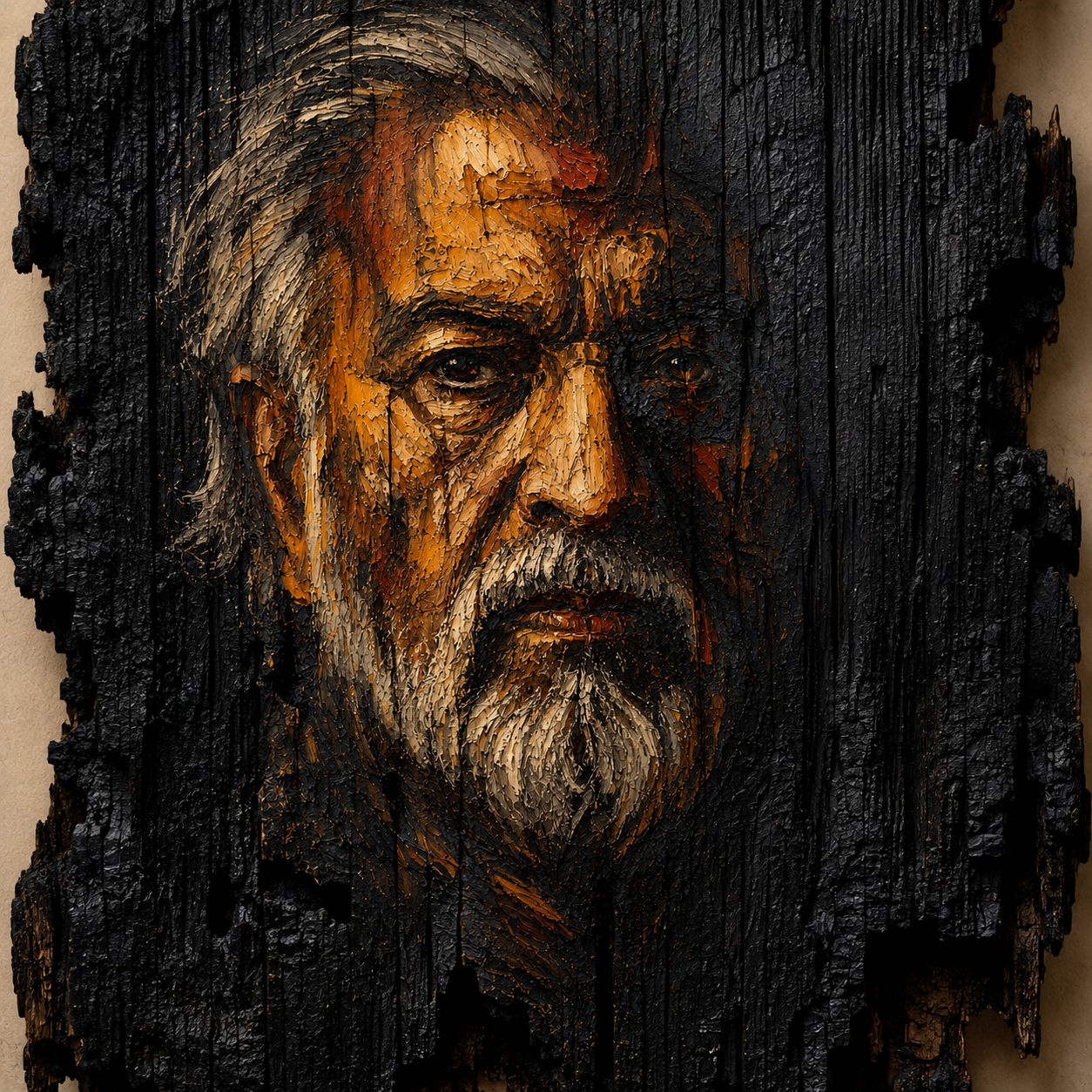
The Burntwood series extended this logic into three dimensions.
Burnt wood. Leather. Cowrie shells. Hemp rope. Metal. Glass. Sooty blackness offset with vermillion and gold. Forms that feel like remnants of violence and fire. The cowrie shells working as small talismans, hope held against devastation.
These were never metaphors layered onto meaning. They were the meaning.
Scarred, charred, bound, the materials hold the residue of lived extremity without narrating it. The works are not illustrations of history. They are its aftermath. What language cannot carry, material holds.
The form does not decorate. It states.
He prepared his canvases in a way few others did. A method of surface treatment developed over decades gave his work a distinct material density before the first mark was made. The discipline began before the painting did. He continued working into his final years, including a large commissioned painting completed late in life, proof that the practice never softened, never slowed, never asked permission to continue.
Gujral cannot be understood through any single medium because he refused to let one settle into comfort. Painting, sculpture, murals, collage, drawing, mosaic, architecture. Each became a site of inquiry rather than a discipline he occupied.
This was not restlessness. It was an ethical position.
Across seven decades, his stance held: against dilution, against simplification, against the easily consumable. He converted lived pain into form without surrendering dignity or restraint. Life actual became life dramatic, and neither was lost in the translation.
The refusal to soften, practiced with discipline over a lifetime, proved generative rather than limiting.
The Belgian Embassy in New Delhi stands among the finest buildings of twentieth-century India. It also stands as proof of Gujral's conviction that art belongs in public space.
For him, scale meant responsibility. Murals. Civic commissions. Public form. He resisted the idea of art as private possession or elite signal. The work commanded attention without asking for admiration. It insisted on encounter without mediation.
His position was unambiguous: "Art is a language that should be spoken in public places."
The institutional record reflects this. Collections at Lalit Kala Akademi, the National Gallery of Modern Art, and internationally, including the British Museum, which holds his 1986 photolithograph Mourning, based on his 1949 painting of women during Partition, acquired directly from the artist in 1988.
The work occupied space not for monumentality but for moral presence.
Padma Vibhushan. Order of the Aztec Eagle. Order of the Crown of Belgium. Among others. The honours arrived. They did not change the work. The work had already decided what it was.
A posthumous legacy operates under different constraints than a living practice.
Gujral's work now exists without its author. No new statements. No clarifications. No corrections. The body of work is fixed. What remains unfixed is how it is encountered, interpreted, and positioned over time.
The pattern in legacy mismanagement is consistent: amplification without discipline, circulation without curation, visibility without narrative integrity. Legacies optimised for reach often dilute the very coherence that made them significant.
Gujral's practice was defined by refusal. Of single medium. Of softening. Of easy absorption into ideology or commerce. The same refusals now govern how his work must be held.
Custodianship, in this context, is not sentiment. It is structural. Management optimises for circulation. Custodianship protects against dilution. The integrity of the legacy depends on whether those who hold it understand what he refused, not only what he made.
In a cultural moment shaped by speed, visibility, and constant assertion, Gujral's practice offers a counter-pattern. Identity formed through restraint. Meaning carried without force. Permanence achieved by refusing to chase relevance.
The work does not instruct. It stands. In standing, it speaks.
"Creation provides me with proof of my being."
Satish Gujral
Most artists seek voice. Gujral found his in silence. Most practices expand toward visibility. His contracted toward density. Most legacies are managed for circulation. His demands custodianship.
The discipline was not in what he made. It was in what he refused to unmake.